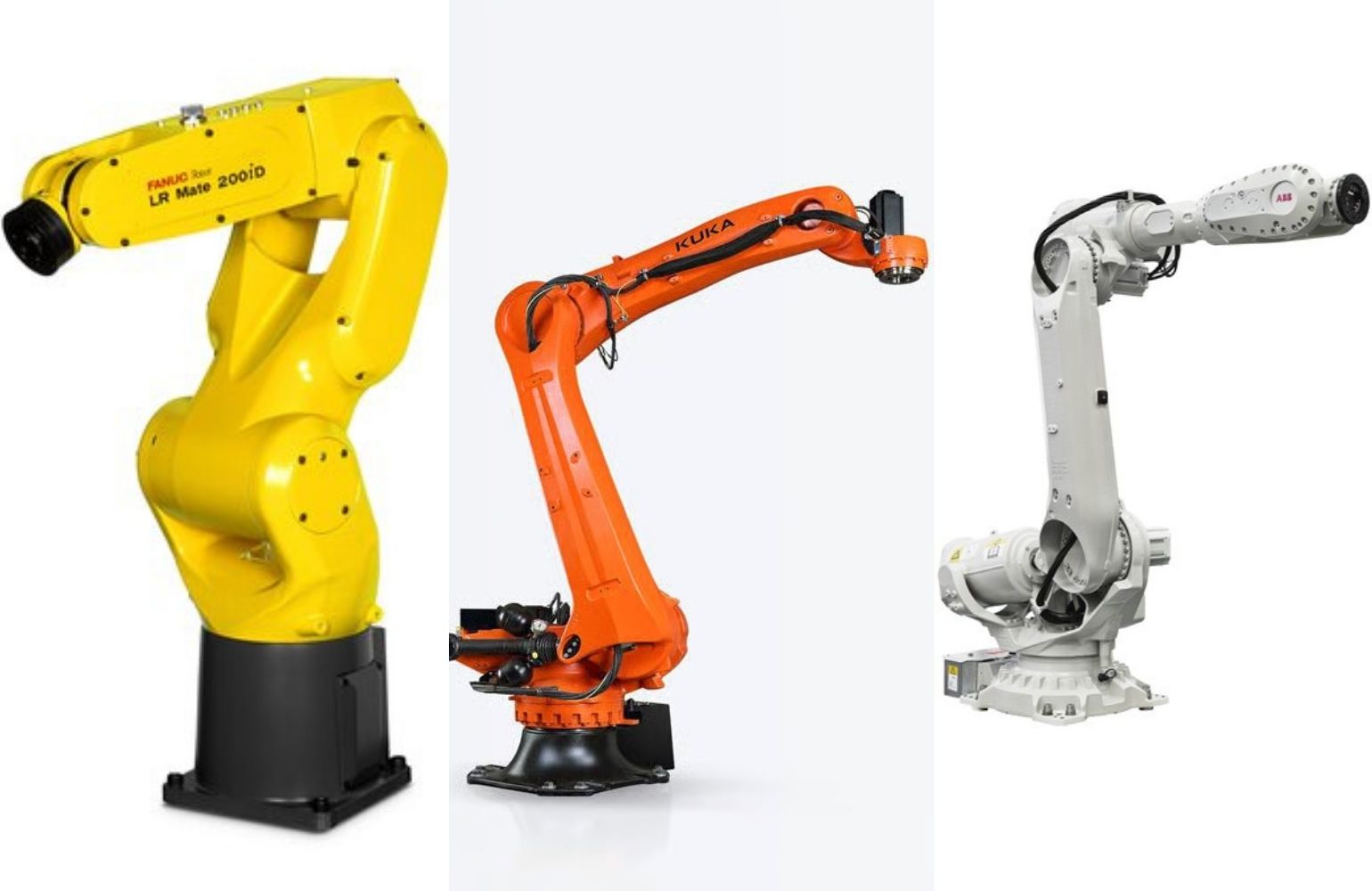
From left to right: The FANUC LR Mate 200 iD, the KUKA KR QUANTEC, and ABB’s IRB 6700. | Source: FANUC, KUKA, ABB Robotics Robotics professionals know how much the industry will grow in the coming years, especially because of the numerous disruptive advancements that keep entering workflows. While automation is the goal, experts are recognizing the importance of mechanical positioning and its impact on the machine’s mobility, range and speed.
Considering these characteristics more comprehensively could yield greater efficiency in automated assembly operations. How precision positioning and components enhance robotics Positioning is essential for a robot’s success because it defines its potential as much as its limitations. This equipment has a fixed reach, regardless of the power and flexibility of its components.
Every machine is inhibited and empowered by its mechanisms, such as its joints and actuators. Additionally, positioning systems enable every component to operate at its maximum potential, making these implementations vital for production. Linear transfer systems Linear transfer systems expand a robot’s range of motion . These include linear and robot transfer units that promote fluid movement along a track.
Using these mechanisms to diversify movement would enable large-scale projects, such as aerospace and defense products, to be largely produced with robotic aids. They could easily move around massive assemblies, executing multiple tasks, compared to stationary robots. Models that are making waves tout seventh-axis mobility and fast deployment.
Rotary index tables Rotary index tables are components that promote precision and speed in repeated processes. They are embedded in robots to enable rapid rotational movement during assembly. The tables amplify equipment by allowing robots to do multiple tasks simultaneously , including assembly, packing, and quality control. Advanced workpiece positioners Multi-axis workpiece positioners enable robots to move in multiple orientations rather than remaining fixed to a plate or pedestal.
If machinery could rotate more than its arms or approach an assembly at a tilt, it could accomplish more complex assignments. In industries like aerospace and automotive , where parts often have unusual shapes and geometries, robots could navigate the space more thoughtfully and shoulder more tasks that would otherwise be performed manually.
Vision-based positioning and compensation Several factors, including software and peripherals such as sensors and cameras , dictate a robot’s movement. Vision-based mechanisms are vital for enabling real-time responsiveness in equipment. If a sensor detects an obstacle, the robot can adjust its position in response to the stimulus.
Over time, repeated adjustments can lead to big-picture misalignments, but technicians can leverage management systems and software controls to regularly review these metrics and ensure consistency. Submit your session idea for the 2026 RoboBusiness Case studies in robotic innovation These robots and their manufacturers exemplify the importance of mechanical positioning and its impact on dexterity and mobility.
FANUC and the LR Mate Series FANUC is a pioneer in industrial automation. It created the LR Mate Series of compact robots to help assemble complex products, such as electronics and medical devices. One metal stamping company, Pentaflex, used FANUC’s technology to improve assembly and efficiency with its legacy setup. Skillful implementation and positioning enabled the business to reduce labor units per shift while making the floor more flexible.
The FANUC LR Mate 200iD, implemented in assembling complex products. | Source: FANUC KUKA and the KR QUANTEC Series German robotics manufacturer KUKA created the KR QUANTEC series for heavy-duty applications. It specializes in linear transfers, which help assemble large automotive or construction products. Meiller Aufzugtüren is a door panel manufacturer that prides itself on high-volume, custom orders, regardless of batch size.
It incorporated the KR QUANTEC robots, which helped keep production efficient with its welding. Two pedestal-mounted robots with unprecedented reach demonstrated the advantages of smart positioning. In these spaces, the robots were able to handle spot welding , forming, stamping, and more. It made every bespoke order more precise by using consistent amounts of energy for each order.
Two KUKA KR QUANTEC models jointly perform welding services. | Source: KUKA ABB and the IRB 6700 ABB created the IRB 6700 multi-axis robot to make tasks like fabrication easier to automate. It is the mastermind behind Japan’s most recent innovation – a 3D-printed railway station. The positioning of its vertical nozzle made it straightforward to manipulate mortar to design the components.
The IRB 6700 also has seven axes of motion, enabling it to build a more complex structure, even on a less-than-ideal surface. In only a week, it designed a practical yet aesthetically appealing structure that could be constructed in six hours. The flexibility and dexterity of machinery like this could save time and money when designing ubiquitous fixtures.
The IRB 6700 from ABB, complete with seven axes of motion. | Source: ABB A future forged in collaboration The future of every manufacturer lies in its scalability and buy-in to automated solutions. Digital transformation is setting competitors apart, and facets of robotics, like mechanical positioning, influence every aspect of automated assembly operations.
Robots will be more likely to deliver the benefits promised by innovators if mechanical positioning systems are optimized and interoperable with future technologies, such as artificial intelligence and machine learning. Then, the synergy between cobots and the workforce will be unmatched in terms of competitiveness and productivity.
About the author Lou Farrell , a senior editor at Revolutionized , has written on the topics of robotics, computing, and technology for years. He has a great passion for the stories he covers and for writing in general. This article is posted with permission. The post Why you should combine robot dexterity with mechanical positioning for complex assembly operations appeared first on The Robot Report .